That very first day we visit the Charles Darwin Station on Santa Cruz Island. This is where the breeding program for the Galapagos Giant Tortoises takes place. Eggs from all over the islands are hatched here and the little Giant Tortoises (a ‘little giant’ tortoise sound like a contradiction in terms), are raised here until the age of 5 when they are released in hopes of survival on their own. We see several huge, ancient tortoises as well as amazing prickly pear cacti that grow into huge trees, some over 400 years old.
Hiking the Galilee on the Jesus Trail
What would Jesus do if he still lived in Israel’s Galilee region? Well, he would likely roam the hills and, as the brochure of the Jesus Trail states, “Jesus didn’t take the bus.” So we do the same – we walk the Galilee, a region of Israel, while we are here.
We are not religious but we do savour this area steeped in history with so many familiar place names. We booked the 4 day hike through Jesus Trail™, which means we still hike just with the two of us, but they arranged our overnight accommodations along the trail, the meals AND they transport our luggage. A perfect arrangement to hike from Nazareth to the Sea of Galilee.
Zambia’s Book Bus
On the way back to the Book Bus compound, Kelly said, “You will want to see Victoria Falls while you are here. And, you know what? I have some funds left over in our budget. Let’s take some of the kids!” So a few days later we pick up 25 children at the community centre, in the Book Bus and take them on a field trip of their lifetime. These children live 10 KM from Victoria Falls but they have never seen it.
A Visit to Myanmar
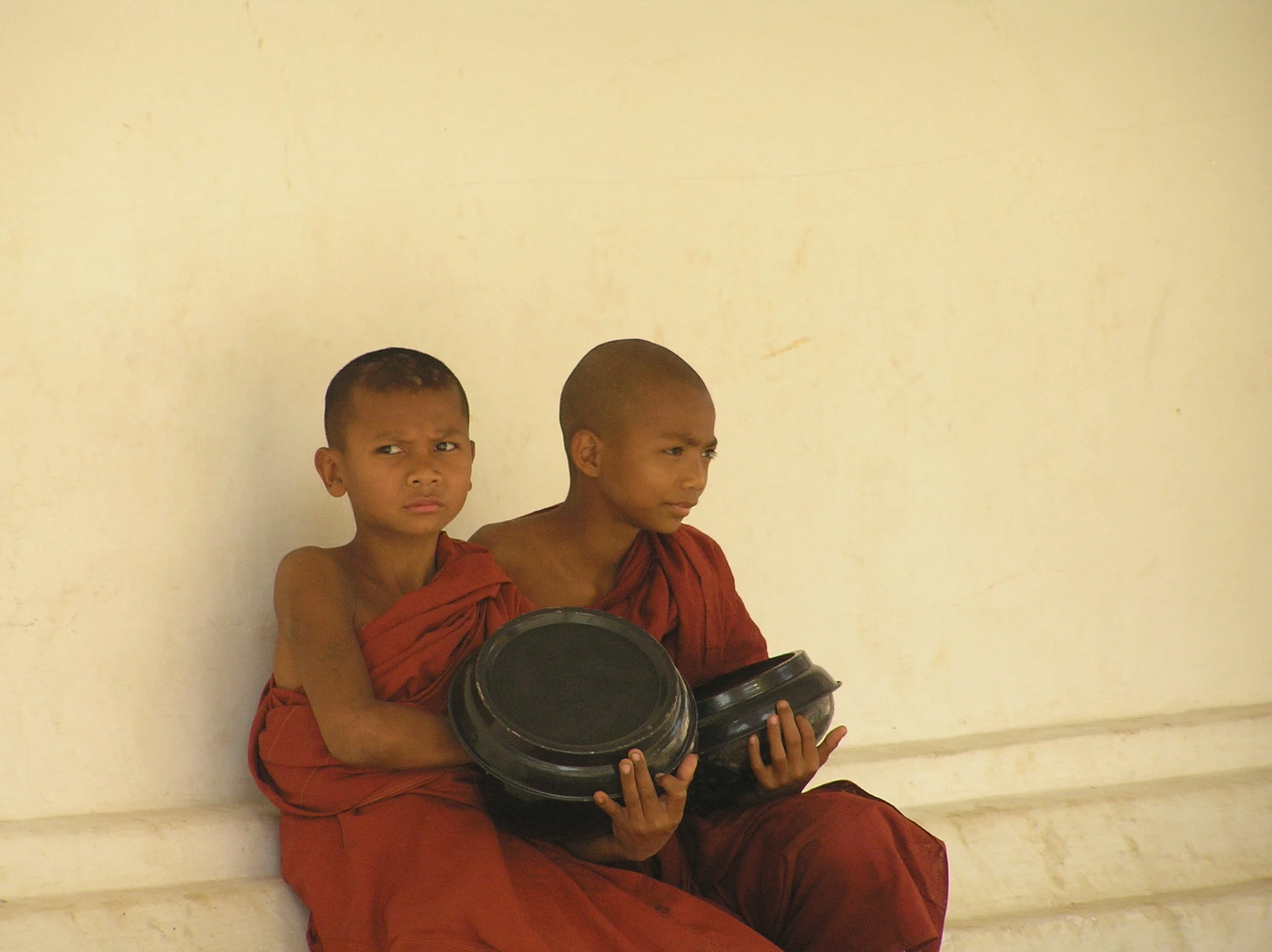
Having just arrived in Myanmar we had no local money yet. The banks here will give less than half of what you get on the black market. So we asked the driver about exchanging money. No problem. He drove deep into a labyrinth of downtown alleyways. Half an hour later he stopped in front of an apartment building and he said ‘give me the money and you stay in the car’. We did feel just a tad worried after he left us parked in an old downtown neighborhood and disappeared…..
It’s About Time: Calendars and Coffee in Ethiopia
Every time I travel to a new place, I am amazed at the things I learn. For instance, did you know that Ethiopia has its very own calendar? And even its own time that is totally different from the rest of the world? I will also show you how coffee is made in Ethiopia - the country where coffee was ‘invented’.
Addis Ababa: a Feast for the Senses
Several international schools in different African countries invited me to come. The librarians and I managed to plan a schedule that worked for the schools and for travel logistics across Africa. Besides working in the schools, I was very much looking forward to seeing a bit of Ethiopia. I knew I would have adventures and learn new things. I didn’t know just how much I didn’t know about this fascinating, unusual country.
Hiking The Dutch Camino: The Pieterpad
Spain has its Camino de Santiago. Canada has the Trans-Canada Trail. Peru boasts the Inca Trail. The Netherlands has the Pieterpad.
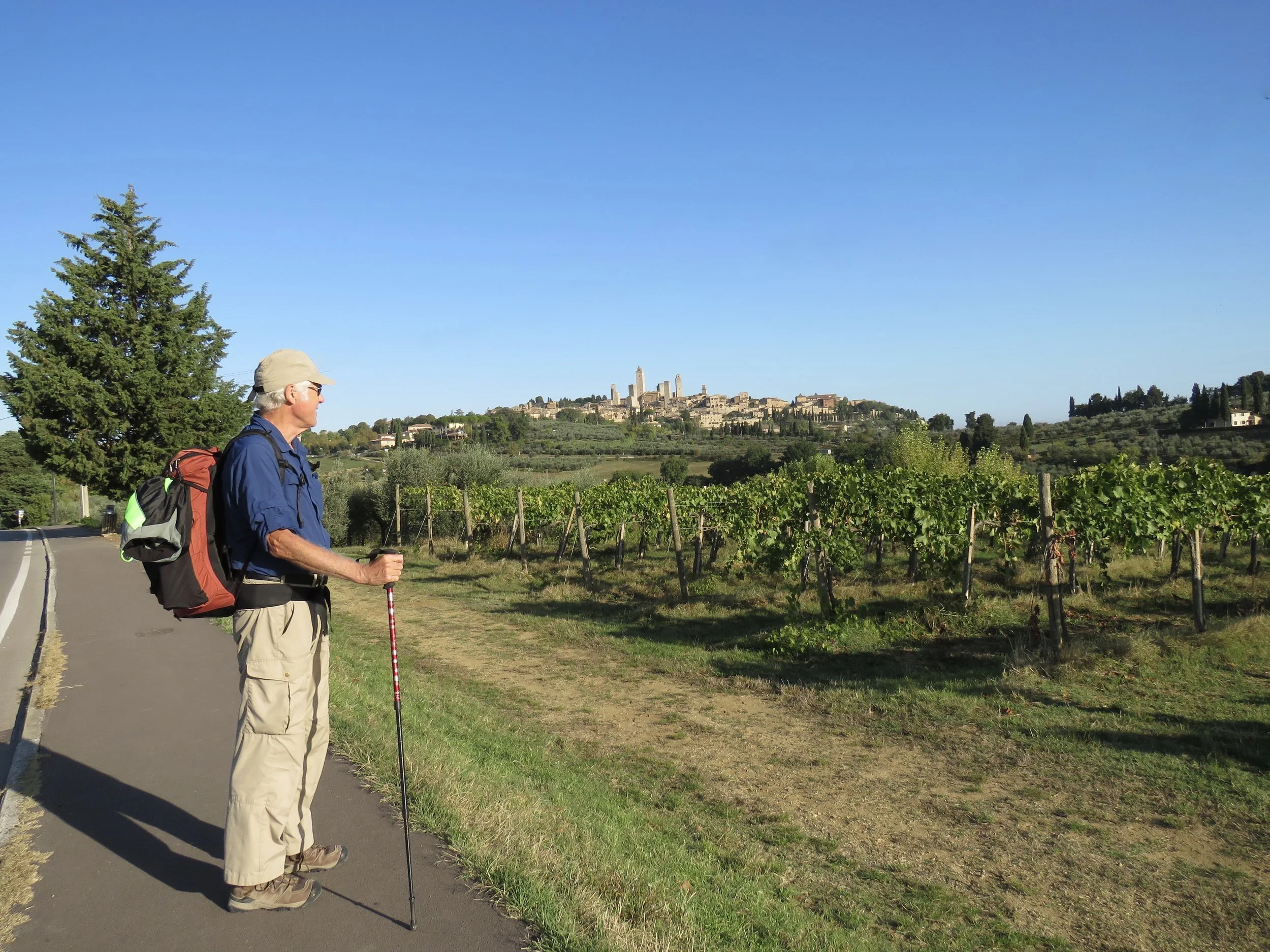
Many of our trips focus on hiking. Kees is the true long-distance hiker in this family, thriving on long days on a trail and a pack on his back. He walked the Camino de Santiago in Spain twice. In this post we’ll share with you one of his favourite long distance trails: the path of St. Peter, or ‘Pieterspad’ in Dutch.
Qatar: Bedouins in BMW's
Qatar - a country where falcons have their own passports, buildings are works of art and more than 90% of the population is foreign. As with all of my travel stories, I do not pretend to truly know Qatar after only visiting here for 2 weeks. My stories are merely aimed at sharing my personal experience. I just hope I don’t get too much wrong, but let me show you dazzling Doha the way I saw it…
Slow Train to Slovakia
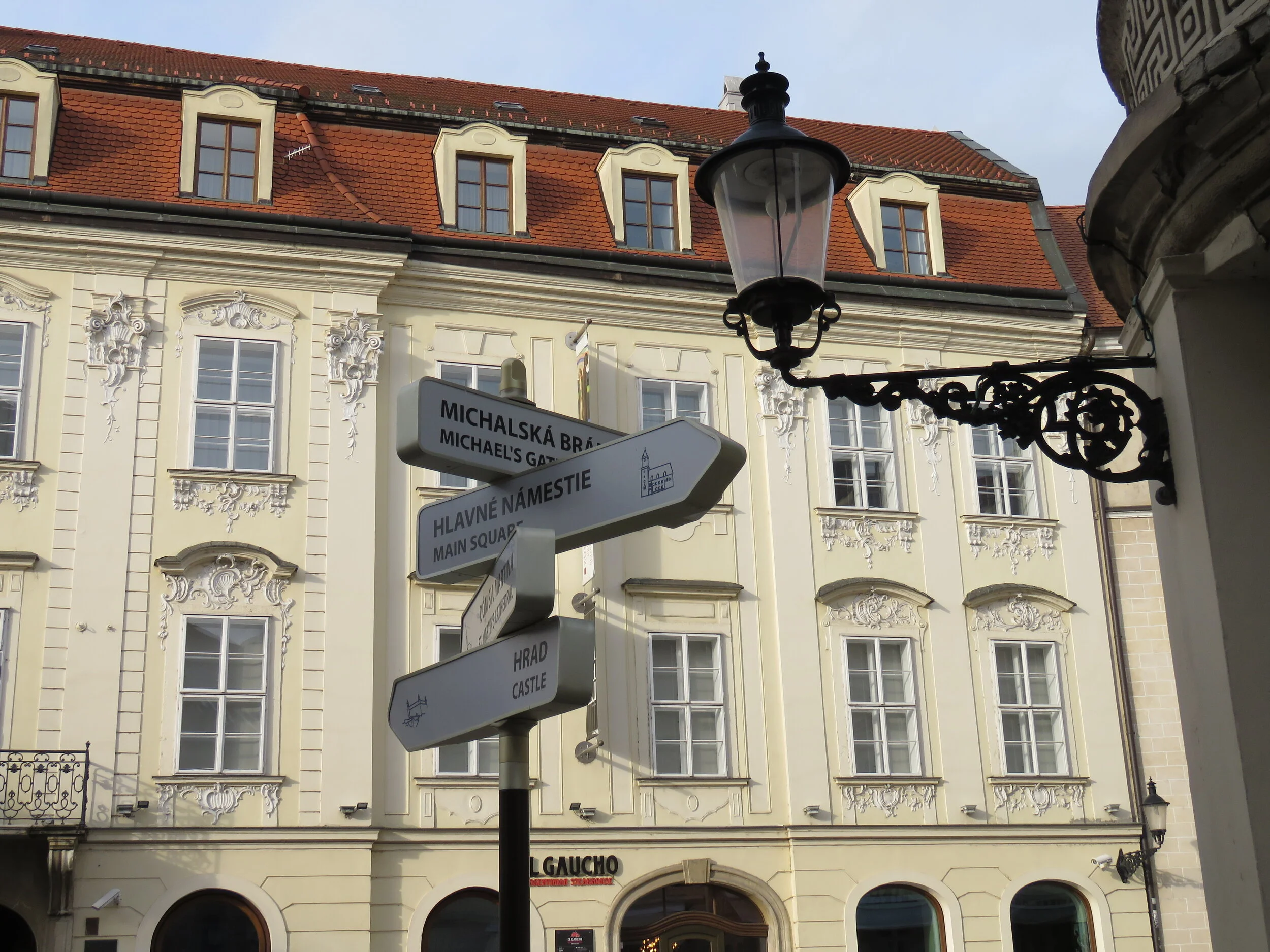
How do you get to Slovakia? We were already so close, in Switzerland. But we discovered that to get to Bratislava, we’d have to spend a fortune and fly via Dubai…. So we ended up flying to Vienna instead, which was cheap and easy. I’ve always wanted to see Vienna but , unfortunately, there was no time. From Vienna, we took a bus to Bratislava, we walked the countryside and ate traditional food.
I Looked Over Jordan and What Did I See?
Before traveling to Petra in Jordan, I had read about Nabataeans living here more than 2,000 years ago. How they carved facades of buildings out of the rocks in which they made their homes. About how Romans eventually conquered them by cutting off their ingenious water supply systems. I had seen pictures of the red rock carvings. I knew that the Siq, the long steep gorge leading to the site, was over a kilometer long.
But indeed nothing prepared me for that first sight of ancient Petra. It truly did take my breath away and left me all choked up.
Nunavut, A Special Place
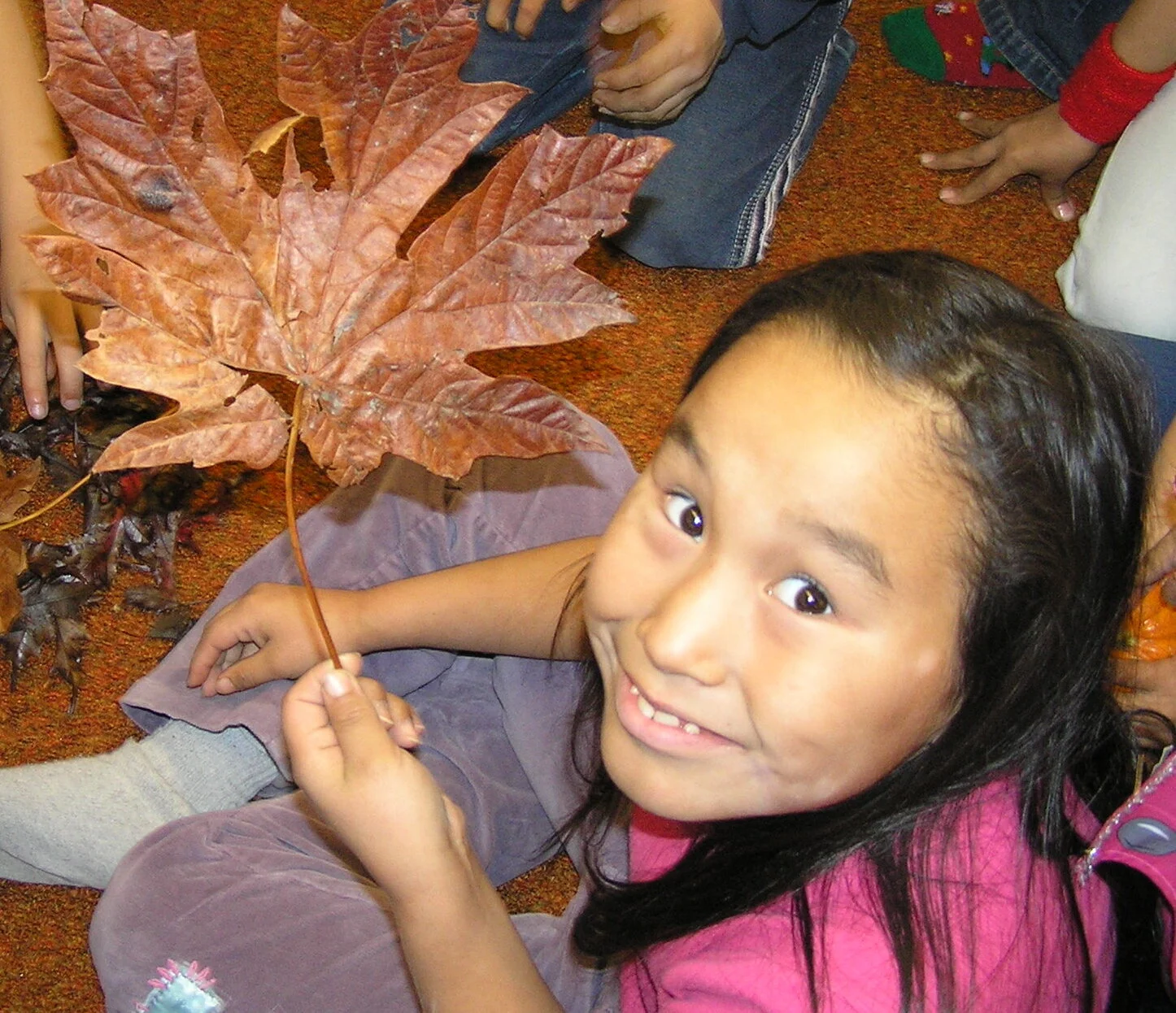
“I flew in a tiny 4 seater plane to the village Kimmirut on Baffin Island. This was a regular line flight but when the pilot heard that this was my first visit to Baffin Island, he enthusiastically called, “Let’s go looking for polar bears!” and followed the ice and tracks in hopes of spotting one from the air. When the airplane buzzed the school, the principal knew it was time to pick up the visiting author and jumped on his snowmobile.”
A Wedding in Pakistan
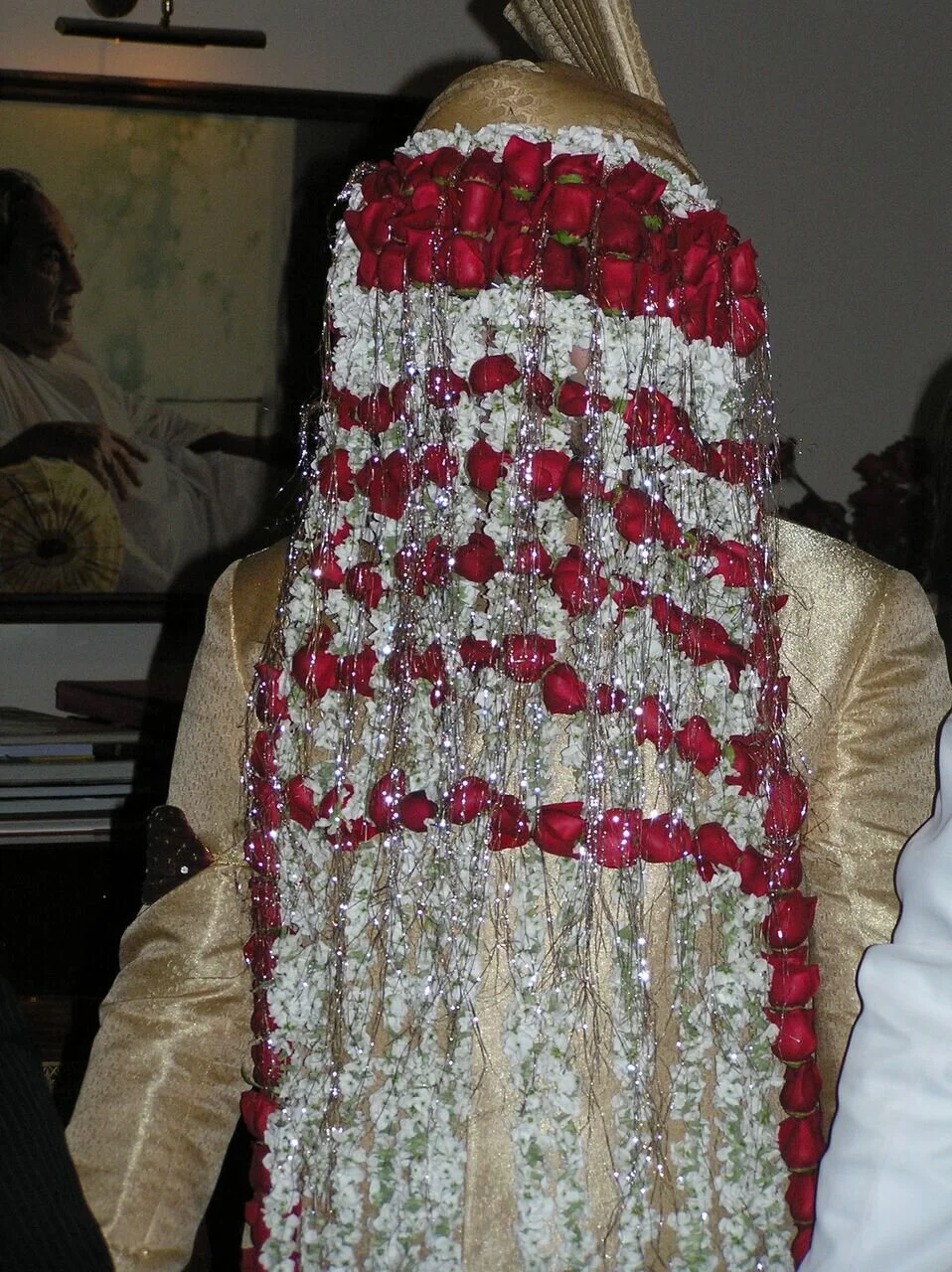
While spending time in Pakistan, I was able to attend five days of wedding ceremonies, had my hands painted with henna, ate the most unusual foods, danced and chatted with many interesting people. Was it an arranged wedding or not? What happened to all the money that was given? Here’s the story of that fairy tale wedding.
ALIF LAILA - Stories from 1001 Nights
If reading printed matter is not a tradition in your culture, how can you address literacy and promote reading among children? Alif Laila runs after school programs, offers girls a chance to learn computer skills, runs Hobby Clubs and is now expanding to include mobile libraries. Ricksaws, busses and even camels bring books to children across Pakistan, children who love to learn about other cultures and much as I loved meeting them.
Enchanting Pakistan
"You are not really going to Pakistan alone? As a woman?" that was the reaction of many when I decided to visit Pakistan. I am writer. And a lovely fellow writer invited me to her country, her home, to be part of her family for a while. We “met” while doing research for a book. She was kind and helpful. And she, too, was a booklover, a teacher. What an opportunity to see a new part of the world.
Mongolia: Into the Gobi With Books
Austria: Where History Lives
Between Lexus and Camels: this is Kazakhstan.
Sauntering and Hiking in Colombia
Potlatch on Haida Gwaii
Potlatch: a party or celebration; among American Indians of the northern Pacific coast, a ceremonial festival at which gifts are bestowed on the guests in a show of wealth that the guests later attempt to surpass.
Having lived in the Yukon I had seen a fair bit of First Nations customs, including button blankets, dances, drumming and celebrations. But once in my life I wanted to experience or, as it is called, to witness a true potlatch.
Thanks to friends in Haida Gwaii, a remote island in northern BC just south of Alaska, I was invited to a potlatch that would celebrate a new chief. The event was held in the village of Skidegate, Haida Gwaii in a hall about the size of a gymnasium.
Along the way I was on a steep learning curve about traditions and about local politics and customs. This was a rare occasion where the sitting chief was ‘dethroned’ by this matriarchal society because the community did not believe that the chief had represented them in the correct ways and may have shown corrupt behaviour in relation to working with Enbridge, an oil company, while the majority of people here do not want a pipe line.
Selecting a new chief had taken several years and painful proceedings. Even now, as the community was ready to celebrate, the family of the ousted chief had the right to be heard first. They spoke at length about the difficult situation and the pain it caused.
As family members finished voicing their concerns, they were respectfully listened to by the entire community, after which they turned their blankets and vests inside out to leave the hall in a way that resembled a funeral.
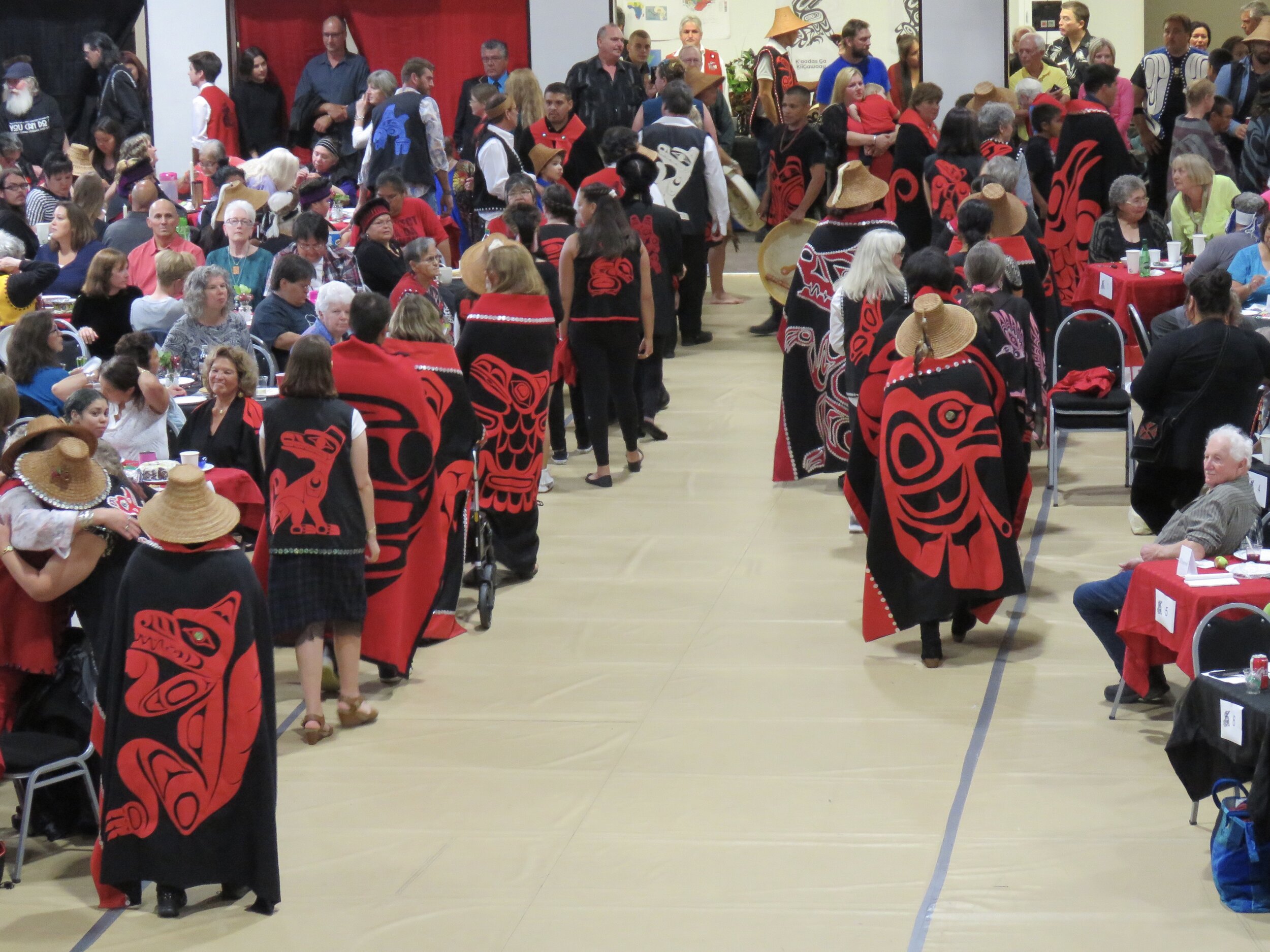
But then the festivities were ready to start. Some 400 people witnessed this potlatch. We were all seated at long tables laden with pies, plates and cutlery. First the room was cleansed through a smudging ceremony at which smoke was danced through the hall to clear the bad words and feelings.
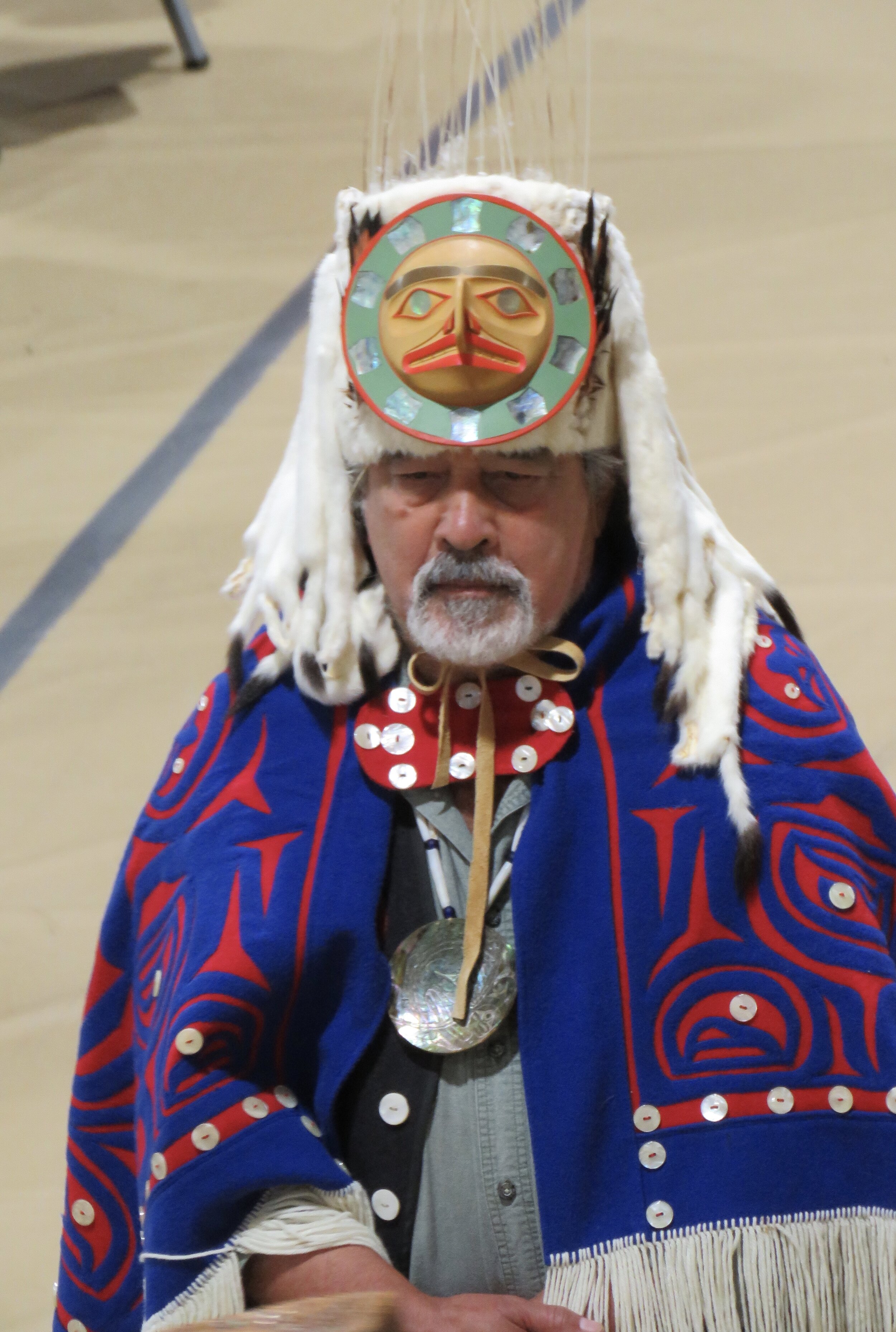
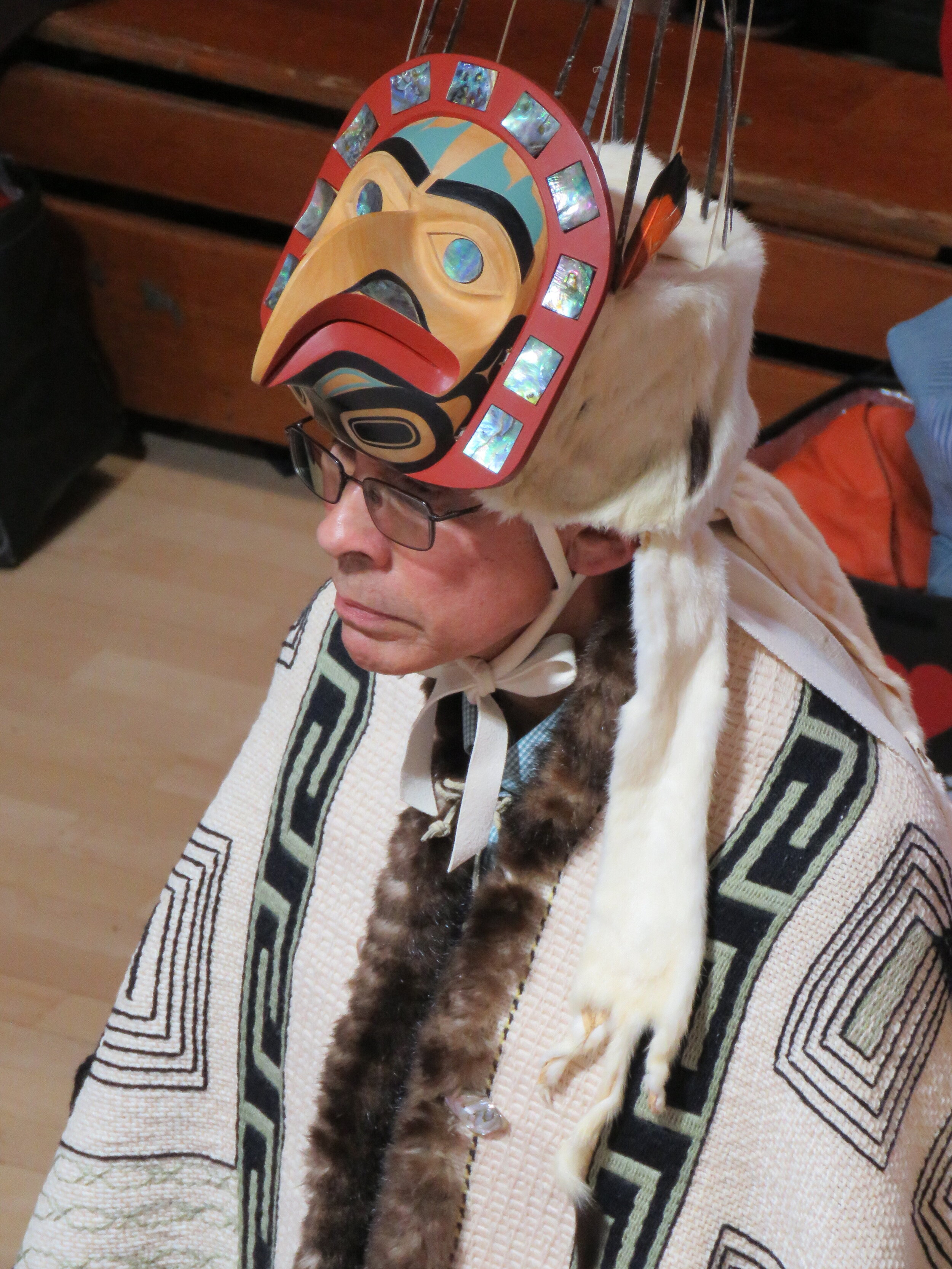
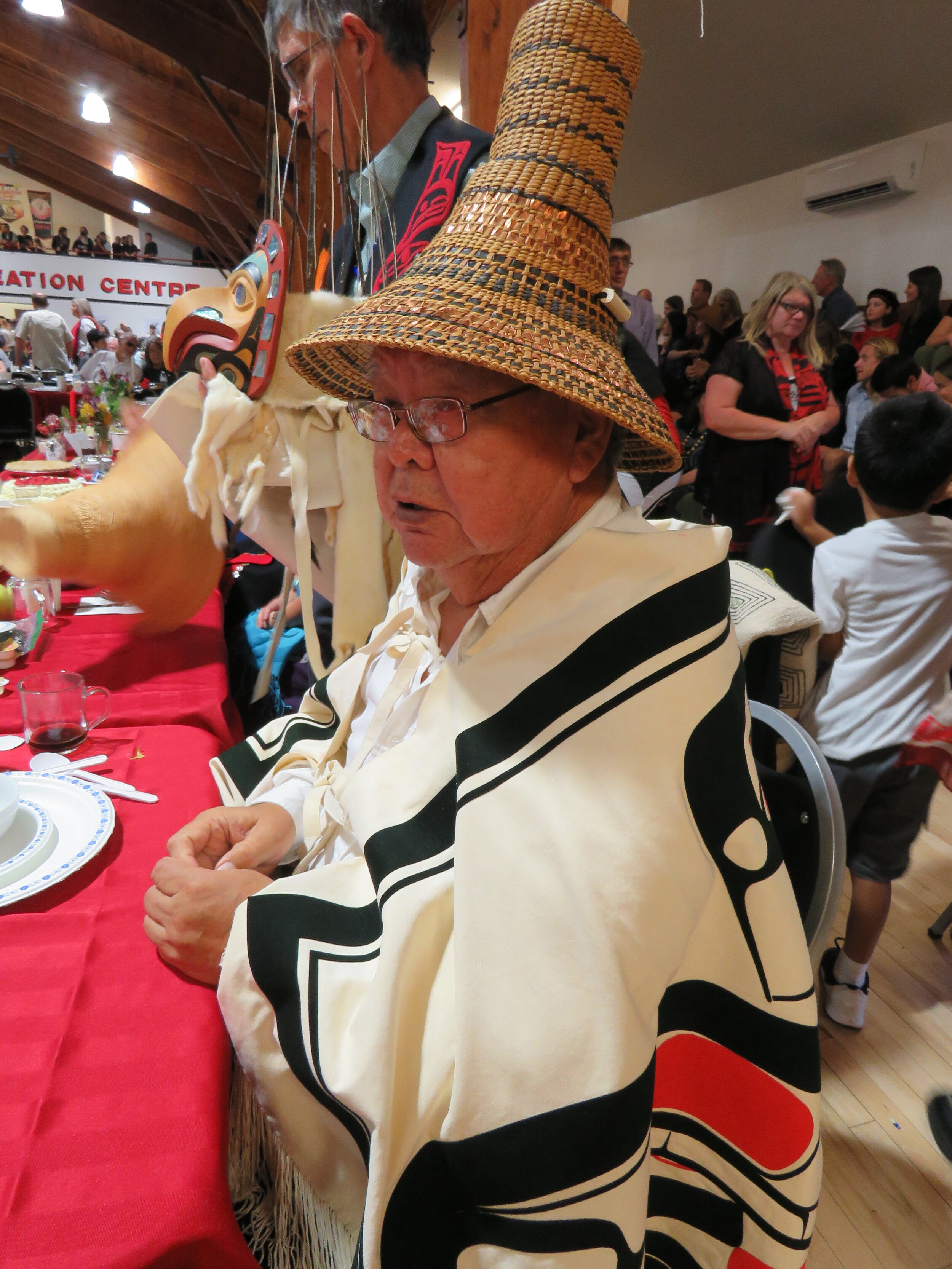
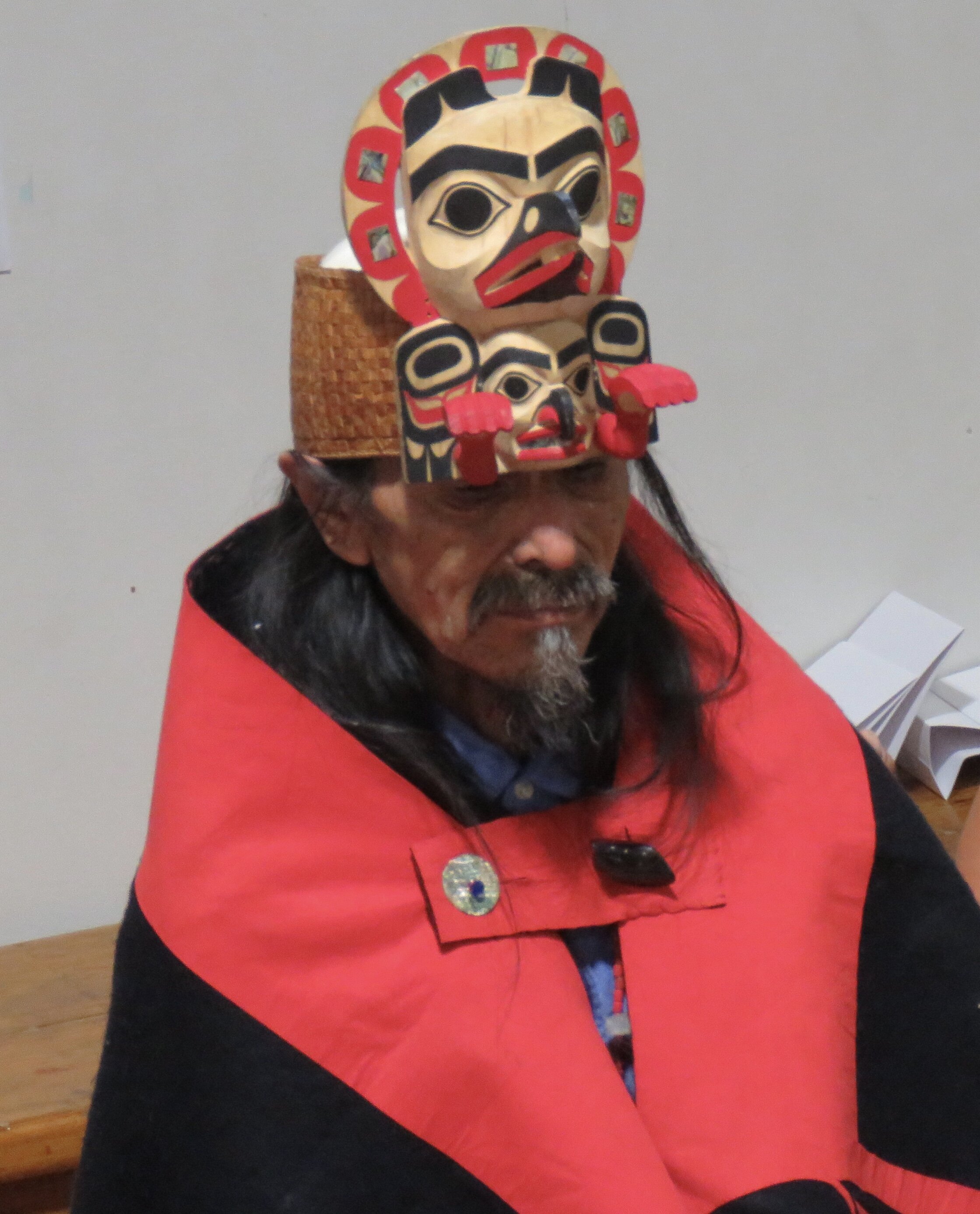
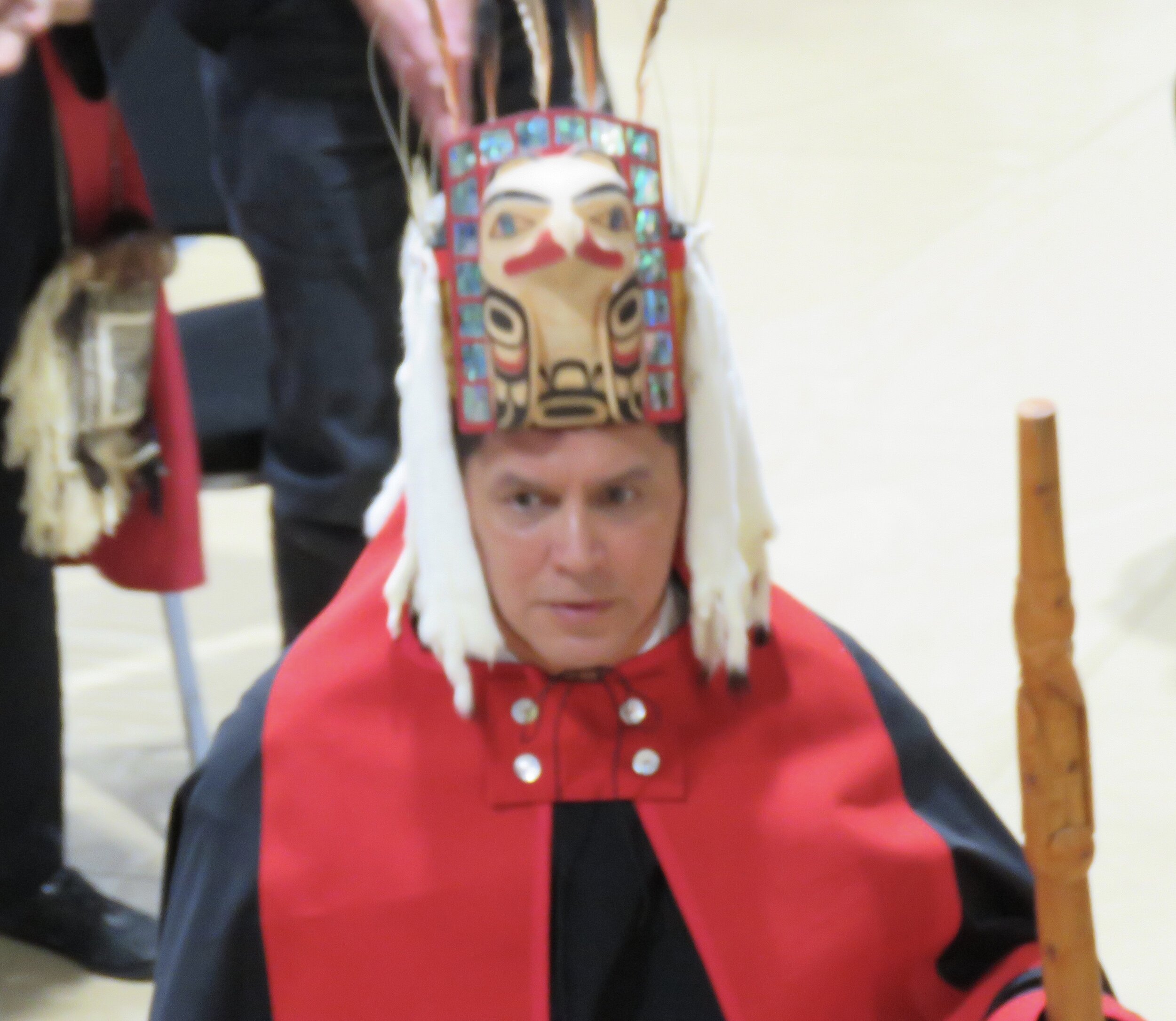
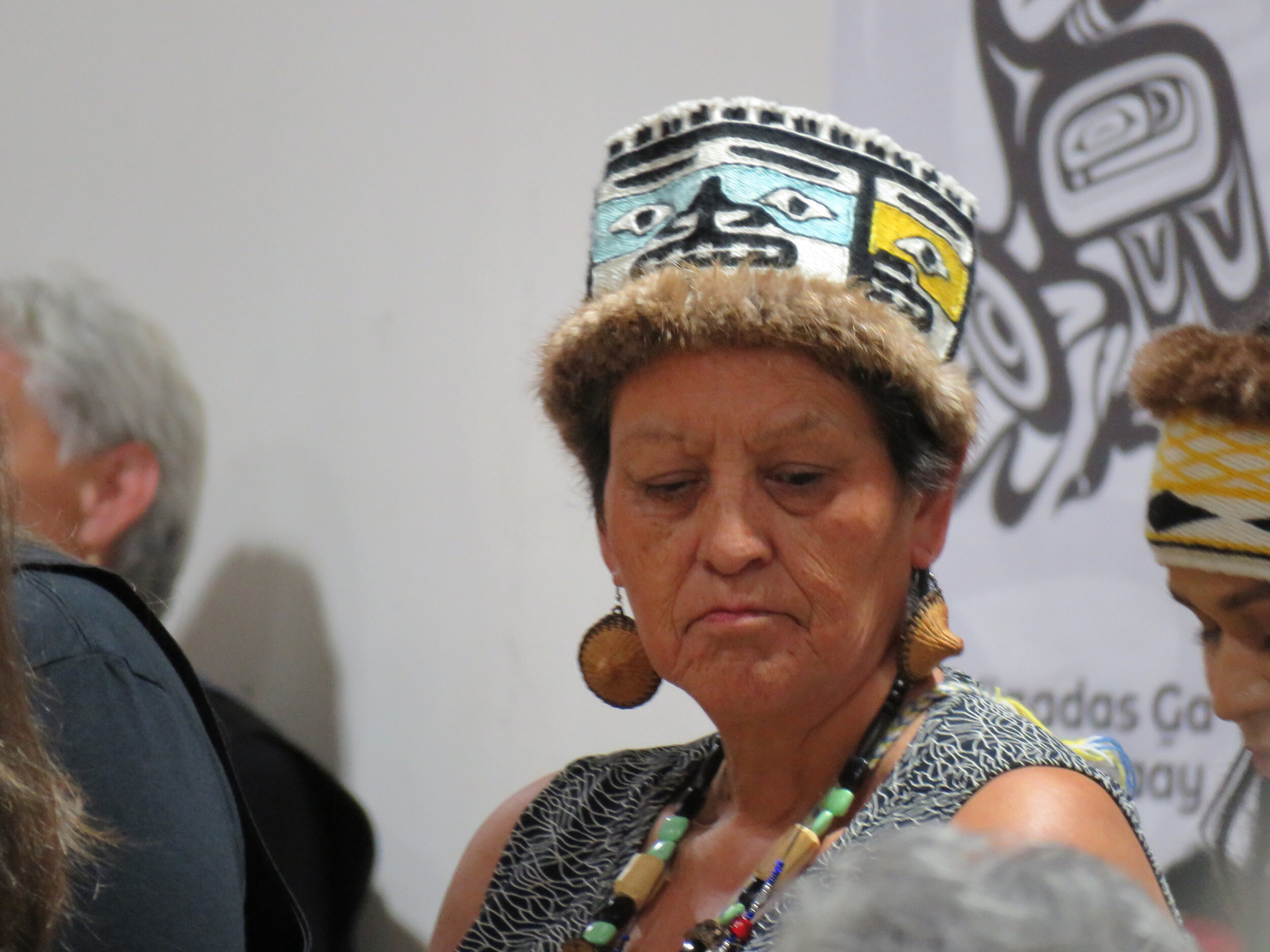
The new chief, surrounded by close family, made his entrance wearing a regular shirt, jeans and mukluks. Then the women closest to him, perhaps his mother or aunties, took newly designed Haida vest and blanket and held them up for all to see. They dressed him, finishing with the carved wooden headgear framed by ermine skins. The top of the headgear was filled with eagle down. When I searched for the significance of this I found the following explanation:
The Haida Peace and Welcome Dance is a traditional dance performed by hereditary chiefs at a Haida potlatch. The welcoming chief wears a robe or colorful button blanket displaying his family crest. Eagle down held in the crown of the eagle frontlet headdress, which is adorned with trailing ermine fur and inlaid abalone shell, is shaken out to float gracefully in a cloud around the dancer during his performance. The eagle down signifies peace and is considered a gesture of welcome from the Haida to their guests. The guest chief would often perform a similar dance in response. If the dances were held inside the Longhouse, the light from the central fire would reflect and flicker on the inlaid abalone shell in the eagle frontlet headdress.’
And indeed, when the chief was fully dressed, he was given his new name and had to ‘dance in’ his name. In doing so, he bowed his head to all of the visiting hereditary chiefs, scattering eagle down as he danced. These chiefs represented other clans, villages and islands.
Many of the chiefs, all dressed in blankets and headgear specific to their clan, spoke. Many of them addressed the sadness of the fact that a chief had to be ousted but their pleasure with the new chief.
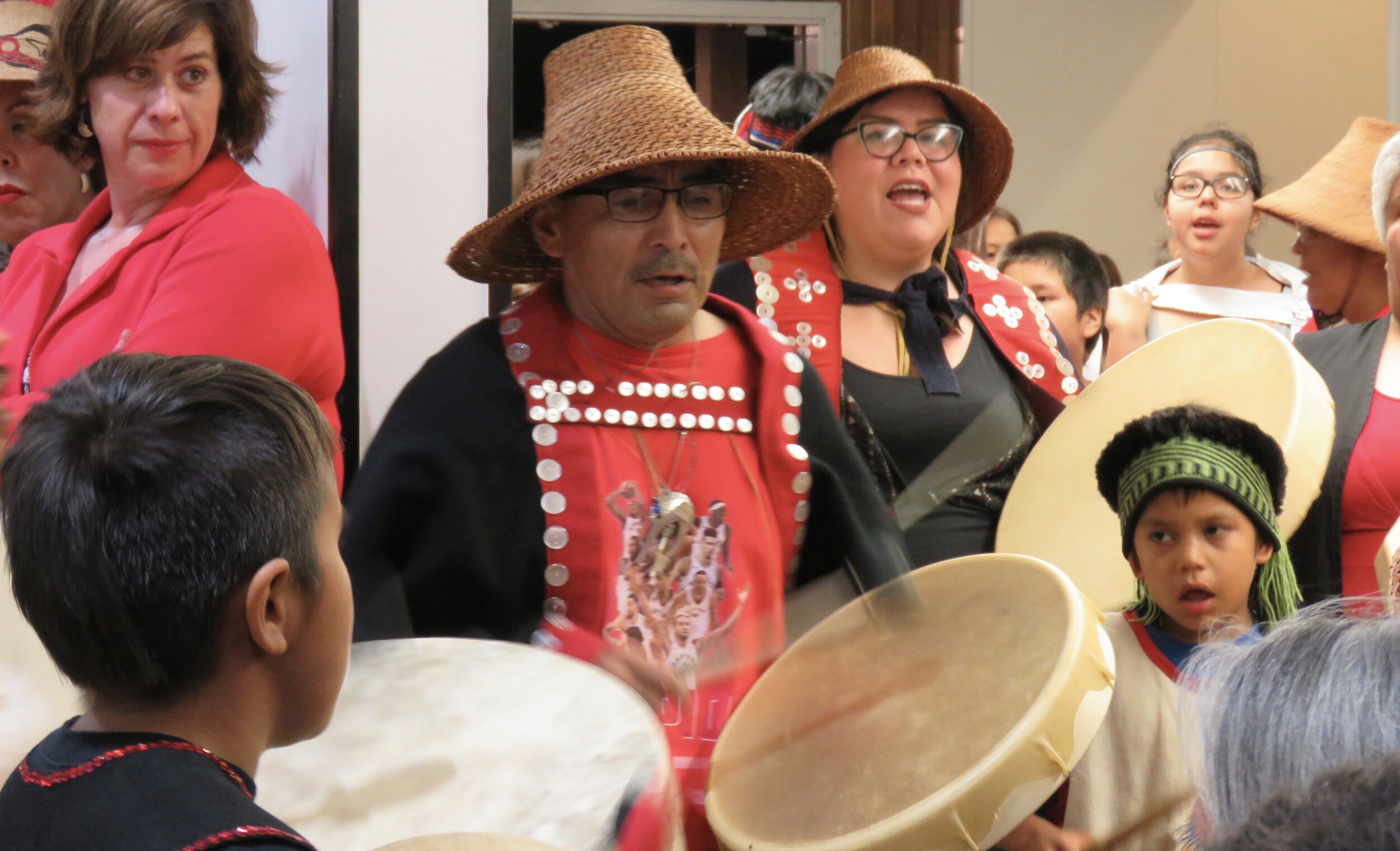
And then they danced. The Eagle Dance was my favourite, with dancers soaring on wide spread ‘wings’ and thrill eagle cries filling the hall to the rafters.
All of this took many hours. In the meanwhile we ate. I am told it takes two years to prepare for a potlatch of this magnitude: fishing, growing vegetables, picking berries, baking breads and pies. There was halibut and smoked salmon, herring roe on seaweed, venison stew, clam cakes, octopus fritters and blueberry pie.
We listened to speeches and watched dancing and drumming for hours, yet the time flew by. I loved seeing all generations come together to celebrate. There were new born babes in arms as their mothers danced, and elders being helped by teenagers.
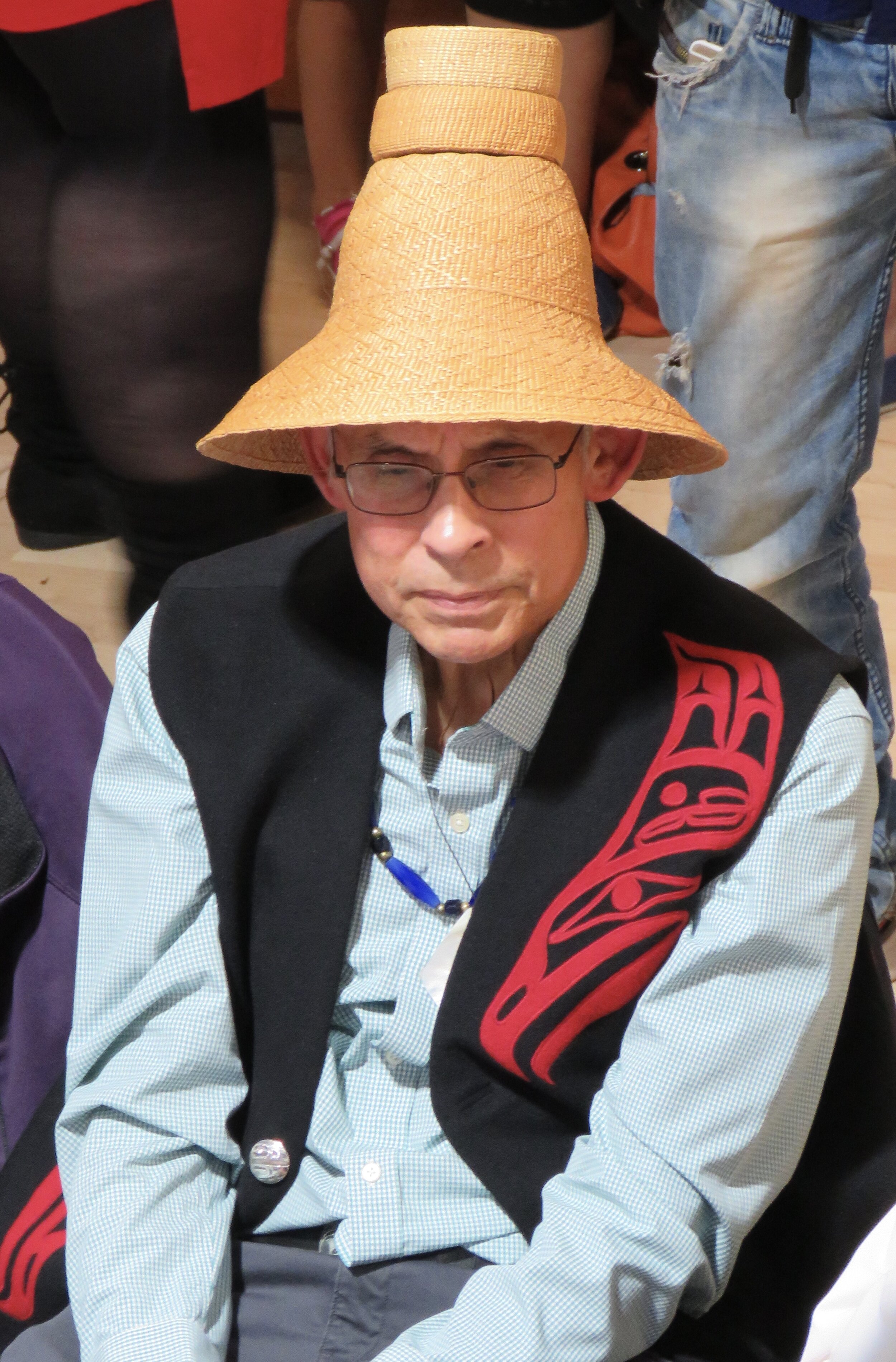
Seeing the multitude of regalia - blankets, ermine, abalone lined masks, woven cedar bark hats, carved ceremonial sticks - was like watching a display in the museum of anthropology come to life. I found it thrilling to witness since I had read many books about potlatches being forbidden by colonial governments as late as the 1950’s. I am so glad that traditions, language and customs of these regal coast Salish people have survived. And so grateful to my friends on Haida Gwaii for allowing me to witness this spectacular event. Haw’aa, haw’aa, thank you.
PLEASE NOTE: all images are copyrighted.
For books about Haida Gwaii, click here, then scroll to Canada.
Australia 20: The Mona - What Is Art?
The Mona
Tasmania’s number one tourist attraction used to be Port Arthur, the convict colony where ruins of prisons tell the story of its gruesome settlement. Now, Tassie’s prime attraction is a museum built by a man with a lot of money made through gambling, a man who wanted to prove something to the world.
The publicity surrounding the opening of David Walsh's pet project, MONA (Museum of Old ad New Art) has made ripples around the world. The unique characteristics of the location, buildings and exhibits continued to please tens of thousands of visitors every month, making it the most visited single attraction in Tasmania. MONA has encouraged people to visit Hobart, who would ordinarily never have contemplated it. Lonely Planet named it the top attraction.
And so we felt compelled to see it, even though we are not ‘into’ art and certain don’t love contemporary art. The least I can say is ‘MONA is unique and thought provoking’. The overall experience of a visit is interesting. I admired the architecture, the way the building unfolds and embraces the natural landscape is a piece of art in its own right.
As far as the art inside is concerned - well, I did not care for any of it. Weird. Outlandish. Bizarre. After a while I felt like I was on drugs.
Each visitor is given an iPhone with a menu that highlights and complements each piece of ‘art’. You can listen to the artist’s musings, read the ‘idea behind the piece’ or a bio. The iPhone will give details on which ever piece you approach and is interactive. You can even save your tour, email it to yourself and continue reading about each piece when you get home. Cool use of technology.
Art includes a handful of ancient Egyptian artifacts but mostly outlandish modern pieces, like a room full of TV’s blaring different channels. I’m sure there’s some socio-economic level of interest to it, but it’s kind of lost on me. There was an entire office with only blank white paper displayed…
A wall full of bees: each one suspended from a thread on the ceiling, creating a 3D piece. Provocative paintings. A video of people crossing a street. A room simulating the inside of a computer. Two brooms on a wall. OK.
A few humorous touches kept us on edge. The museum owner’s parking spot is identified as ‘God’s parking spot’. He must have a sense of humor. I hope. But mostly he must have a lot of money. Personally, I think there are better ways to put that money to use than to spend it on a trampoline with buddhist bells underneath or a blank library, a room entirely filled with blank white books.
Do I think it’s worth a visit? I’m not sure. In a way it was a waste of time and money. On the other hand, it got me thinking. What is art?
And perhaps that was the only motivation that drove David Walsh to build MONA...
“As a boy I had limited access to the great repositories
of artefact but I, like most of us, held a library card.
A real treasure. If a museum is a cultural gemstone
then a book is cultural Lego.”
-David Walsh
And then our three months down-under were over. We finished off with a grand finale: the Seekers’ farewell concert in Hobart. So long, Australia, we’ll be back some time.